Service area
House Painters in Nepean
Postwar bungalows and 1970s split levels, with finished basements that carry their own humidity.

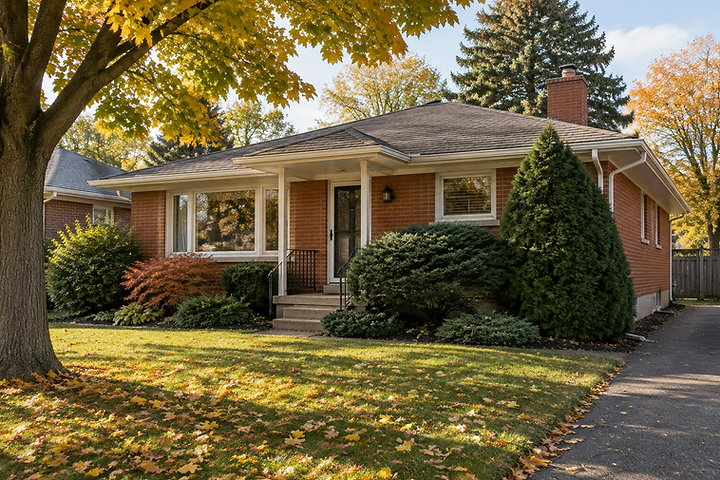
Nepean covers a wide band of the city, and the housing changes block by block. Bells Corners and Trend-Arlington hold 1950s and 1960s bungalows with low roofs, brick fronts and carports that were later enclosed. City View and the streets around the experimental farm edge hold smaller postwar houses. Further west, the 1970s and 1980s split levels and two storeys arrived with finished basements and wider lots.
That mix means the first question on a Nepean project is usually about age. A 1962 bungalow may have plaster walls, original fir trim and a brick exterior that has never been painted. A 1979 split level is more likely to have drywall, factory painted doors and an exterior of brick with aluminium fascia. The two need different preparation before a brush is opened.
Also serving
Barrhaven, Kanata and Westboro are all within a short drive of Nepean.
02 / Surfaces
Plaster, brick and basements that hold moisture.
Plaster is the defining interior surface in the oldest Nepean houses, and it behaves differently from drywall. It is harder, cooler and denser, and it holds a matte finish with a depth that drywall does not quite match. It also cracks, in the same places, every winter, as the framing around it moves with the temperature.
Exteriors are mostly brick with painted wood or aluminium trim. Brick from this era has usually been left unpainted, which is fortunate, and the trim is where the work is: fascia, soffit edges, window casings, door frames and the porch or carport posts. Paint on that trim has often been built up over decades, and where it has cracked along the grain it needs to be taken back rather than covered.
Finished basements are their own category. Panelled walls, drop ceilings, and a concrete floor that wicks moisture all affect how a coating performs. We look at the humidity and any signs of staining before recommending a product, because a finish applied over a damp wall will fail and take the repair with it.
03 / Access
Wide driveways and mature maple canopy.
Most Nepean houses have a driveway and a front lawn wide enough for safe ladder placement, which makes exterior work easier than it is downtown. The complication is trees: the maples and cedars planted in the 1960s are now large, and they shade the elevations and drop debris onto roofs and gutters. Shade slows drying, which matters for exterior coatings.
Inside, bungalows are simple to sequence because most rooms sit on one level. Split levels need more planning, since the stair is the only route between floors and it has to stay open. We work the upper level and the lower level in an order that keeps one route usable throughout.
04 / The season
Shade, dew and the autumn closing window.
Exterior work in Nepean has to account for shade. A north elevation under a maple canopy stays damp well into the morning, and a coating applied before it has dried will not bond properly. We start later on shaded elevations and work the sunny ones first, which is a slower approach but a more reliable one.
The window closes earlier here than people expect, because the tree canopy holds moisture and the nights cool quickly in September. If exterior trim has started to fail, the fix is better done in July than in October.
Interior work suits the winter months particularly well in these houses, since the rooms are separate and can be taken one at a time.
Painting questions in Nepean.
Services in Nepean
Services
Request a consultation.
Tell us the era of the house and whether the walls are plaster or drywall. It shapes both the preparation and the schedule.
Request a consultation
Tell us a little about the space and the work. We reply by email with next steps and a time to walk through the project.