Service
Commercial Painting in Ottawa
Offices, retail, restaurants and common areas, staged around the way the space has to keep working.
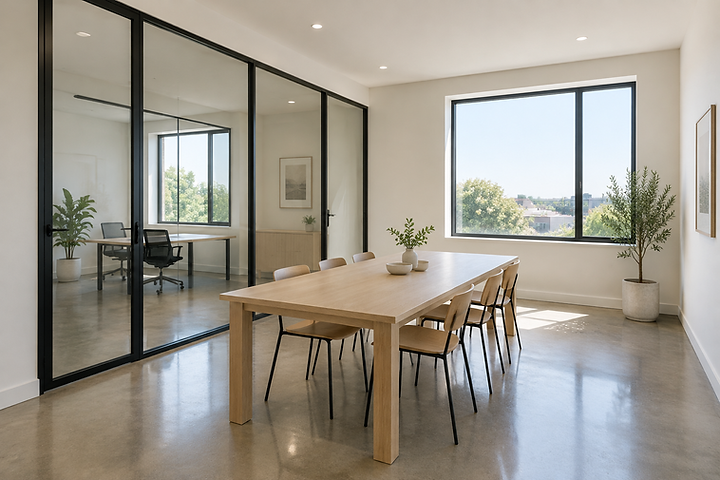
Commercial painting is judged differently from residential work. A wall in a busy corridor is looked at from a distance and touched by hundreds of people. A restaurant dining room has to look finished by the time the doors open. An office repaint has to happen around desks, cabling and meetings without stopping the business.
We paint offices, retail floors, restaurants and cafes, clinics, common areas, stairwells and corridors, and the interior of light industrial and warehouse office space. That includes walls, ceilings, columns, doors and frames, exposed structure where it is painted, and the drywall repairs that always turn up once furniture is moved.
- Offices and meeting rooms
- Retail floors and fitting rooms
- Restaurants and cafes
- Corridors and stairwells
- Washrooms and staff areas
- Drywall repair and patching
Access
Evening and weekend windows on request. Building requirements followed.
02 / Preparation
Working around the business.
Preparation in a commercial space is as much about logistics as surfaces. Furniture is consolidated, cabling is protected or disconnected with permission, and the work area is separated with a taped barrier. Dust from sanding is controlled at the source, because fine dust travelling through an air handling system is a much bigger problem in an office than in a house.
Surfaces are then treated on their merits. Drywall is patched and sanded where shelving, signage or furniture has left holes. Scuffed corridors are cleaned and spot primed. Previously painted walls that have gone chalky from cleaning products are washed and sealed so the new coat adheres. Door frames and push plates, which take the most contact, are dulled and primed for a harder finish.
Floors are protected along the whole route, not only in the room being painted. In a commercial building the path from the entrance to the work area matters, and protection is laid before the first tin is opened.
The measure of commercial work is simple: the space has to be usable again when the doors open.
03 / Products and sheens
Washable, low odour, and chosen for the room.
Commercial interiors usually take waterborne acrylic finishes, partly for the low odour and fast recoat time that allow a space to reopen quickly, and partly because they are easy to touch up later. Where a harder film is needed on doors, frames and handrails, a waterborne enamel or an alkyd is used.
Sheen goes up as cleanability matters more. Corridors, washrooms and food service areas are usually finished in eggshell, satin or semi gloss so they can be wiped and scrubbed. Office walls often take a matte or eggshell finish for a calmer look, with the higher sheens reserved for the parts that take contact.
Ceilings in commercial space are frequently a flat white, both for light reflection and because the surface above eye level rarely justifies a more expensive finish. In exposed structure, the coating is chosen for the substrate and for how accessible it will be for future maintenance.
04 / Ottawa notes
Downtown access, loading and building rules.
Most commercial work in Ottawa sits in buildings with their own constraints. Downtown addresses in Centretown may have no loading zone, so materials arrive on a schedule that matches a short term parking allowance. Buildings with a single elevator need a booking. Buildings with a shared corridor need protection laid down before anything is carried through.
In winter, the practical constraint is salt and moisture on floors and stairs, which is another reason protection goes down early. In summer, restaurants often want the work done before patio season opens or in the quiet weeks after it closes, and we plan the calendar around that rather than the other way around.
05 / Scheduling
Planning a window that works.
The useful conversation is about the window, not the duration. Tell us when the space can be out of use, even partially, and what has to be back in service by the morning. From there we can plan the sequence, the products and the access.
For spaces that cannot close at all, we divide the work into areas small enough to complete between openings. For spaces that can close for a defined period, the work runs faster in one continuous sequence. Both are possible, and the choice belongs to the business rather than to us.
Commercial painting questions.
Request a consultation.
Tell us the type of space, the hours available and who else needs to approve the work.
Request a consultation
Tell us a little about the space and the work. We reply by email with next steps and a time to walk through the project.