Service
Cabinet Painting in Ottawa
Kitchen and bathroom cabinetry, cleaned and degreased, sanded, primed and finished with the doors and hardware off.
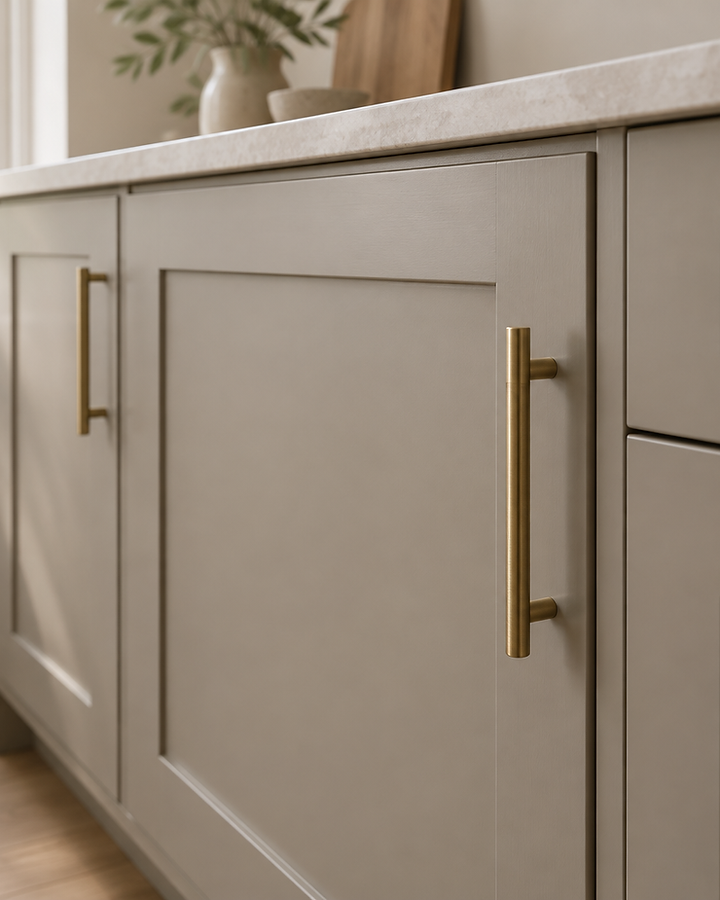
Cabinet painting changes a room more than almost any other painting work, because cabinetry fills the space and sets its tone. It is also the most demanding interior surface to finish, because the doors are viewed straight on, at close range, with light raking across them from a window or an under cabinet light.
We paint kitchen and bathroom cabinets, including door fronts, drawer fronts, frames, end panels, toe kicks and the visible side panels. Doors and drawers are removed and finished flat. Hinges, handles and pulls come off. Where an exposed shelf or a range hood surround is part of the run, it is included in the same finish.
- Doors and drawer fronts
- Cabinet frames and boxes
- End panels and filler strips
- Toe kicks and trim
- Vanity cabinetry
- Built in shelving and surrounds
Note
The kitchen is out of use for part of the work. We agree the timing before we start.
02 / Preparation
Degreasing is the step that decides everything.
Kitchen cabinets carry a film of cooking grease that is invisible but fatal to adhesion. Warm water and a household cleaner will not remove it. The surfaces are degreased with a product that cuts through it, then rinsed, then checked by hand before any sanding begins. A door that is not fully degreased will fail at the edges within a year.
Sanding comes next. The purpose is twofold: to remove the sheen from a factory finish so the primer can bond, and to flatten any grain that raises after the first coat. On a painted cabinet, the raised grain between coats is what makes the difference between a surface that looks painted and one that looks finished.
Priming is chosen for the substrate. A bonding primer grips a factory lacquer or a previously painted surface. Bare wood takes a sanding sealer or a primer that raises the grain deliberately so it can be cut back. Knots are sealed so the resin does not bleed through the topcoat. Caulking at the joints between frame and wall is done before primer so the line is clean.
Hardware and masking come before spraying. Hinges are bagged and labelled, openings are masked, and the kitchen is separated from the rest of the house with a taped plastic barrier so that overspray and dust stay in one room.
A cabinet door is viewed straight on and at arm's length. There is nowhere for a rushed edge to hide.
03 / Products and application
Sprayed doors, brushed frames, one finish.
Doors and drawer fronts are finished flat, off the cabinet, so the film can level without runs. Spraying gives the most even result on a flat panel and works into the profile of a shaker rail cleanly. Brushing and rolling are used where spraying is not practical, and on the frames in place, where the paint has to be worked around the interior of the box.
The topcoat is a hard waterborne enamel or an alkyd, chosen for the colour and the wear the kitchen sees. Waterborne enamels have low odour, resist yellowing and cure to a durable film, which makes them the usual choice in an occupied home. Alkyd gives a denser, glassier finish and takes longer to cure.
Sheen is usually satin or semi gloss on cabinetry: washable, and forgiving of the small imperfections that any existing cabinet carries. A matte finish on cabinets is possible and looks calm, but it marks more easily around handles and is harder to wipe clean.
04 / Ottawa notes
Humidity, heat and the kitchen you cook in.
Cabinet work in Ottawa follows the same seasonal logic as other interior work, with one addition: kitchens are humid rooms. A bathroom vanity and a kitchen near a kettle and a dishwasher see repeated swings in moisture, which is why a fully cured hard finish and a well sealed edge matter more here than on a hallway wall.
Winter is a popular time for this work, because the kitchen is the room people are most willing to reorganise for a short period, and the dry indoor air helps waterborne finishes cure. We plan the sequence so that the most used cabinets come back into service as early as the finish allows.
05 / Scheduling
What the work means for the household.
Cabinet painting is disruptive in a specific way: the kitchen is partly unusable while the doors are off and the frames are wet. We tell you in advance which days the sink, counters and cupboards will be out of action, and we keep the doors labelled and stored so that nothing is misplaced.
If the kitchen is the only one in the house, it is worth planning meals and a temporary setup for the middle of the job. If the work is a bathroom vanity or a single run of built ins, the disruption is much smaller. We will give you a realistic picture of both.
Cabinet painting questions.
Request a consultation.
Tell us the cabinet finish, the colour you have in mind and how the kitchen is used.
Request a consultation
Tell us a little about the space and the work. We reply by email with next steps and a time to walk through the project.